This browser tool flags open-weight AI model IDs against licence clauses including domicile exclusions, user caps, non-commercial terms, and attribution.

Try it freeFull version · $149 once →
What you get: a generated NOTICE / attribution file and a dated per-model obligation report for the whole workspace, in the form procurement and counsel ask for, plus a CI exit code so a new model ID cannot land…
Updated 2026-09-14 · ReadyStack
Flags open-weight AI model IDs in your code against their real licence clauses: EU-domicile exclusion, 700M MAU cap, non-commercial weights, missing Built with Llama attribution. Runs entirely in your browser — nothing is uploaded.
Export the NOTICE file and the workspace obligation report
$29 once, one licence key per person or team seat. Outside technology counsel bills roughly $350-600 an hour for an open-source and model-licence review.
Same engine as the VS Code extension, byte for byte.
Free for the file open in your editor - no key, no limit. The workspace sweep and the report ask for a key.
VS Code MarketplaceOpen VSX (Cursor, VSCodium)npmMCP server (npx)ext install ReadyStack.ai-model-license-lint npx @readystack/ai-model-license-lint <file> npx @readystack/ai-model-license-lint --mcp
Team? One key for every ReadyStack linter, 5 seats, $149 once
Exports the evidence: a generated NOTICE / attribution file and a dated per-model obligation report for the whole workspace, in the form procurement and counsel ask for, plus a CI exit code so a new model ID cannot land unreviewed.
One payment, one licence key for this tool. The key is shown right after payment.
Outside technology counsel bills roughly USD 350-600 per hour for an open-source and model-licence review, repeated each time the model list changes
Buy the full version — $29Need more than this one? ReadyStack Pass opens all 679 files and 561 full versions — $29/month or $199/year. See the Pass →
· ReadyStack
Real numbers from this tool, line by line.
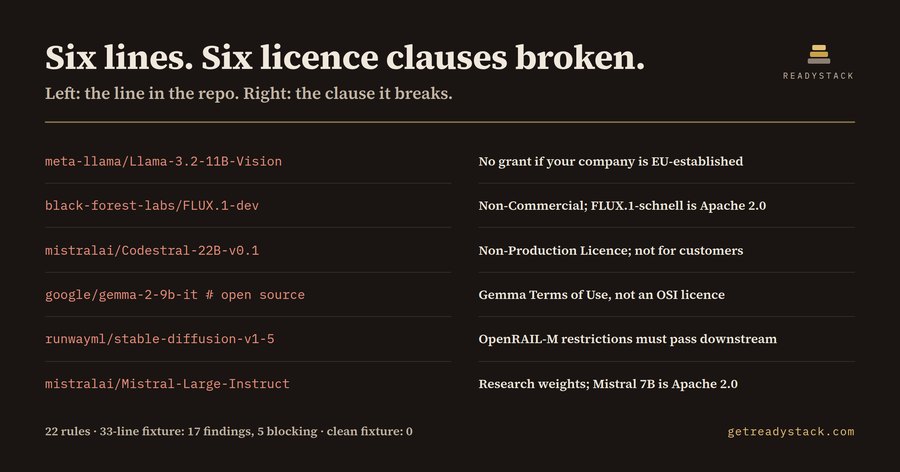
Six model identifiers in one file, six licence clauses broken - that is what thirty-three lines of ordinary model-loading code returned for an engineer at an EU-established software company. Seventeen findings in total, five of them blocking, naming seven distinct licences. The same linter run over a loader that pins Whisper, Mistral 7B and Qwen2.5-7B, with revisions and an attribution file, returns zero.
The first finding is the one people do not expect. The line was meta-llama/Llama-3.2-11B-Vision-Instruct, suggested by a code assistant, and it worked on the first try. The Llama 3.2 Community License withholds its grant for the multimodal builds from individuals domiciled in, and companies with a principal place of business in, the European Union. An EU-established team running those weights does not have a narrower licence than an American one. It has none. Nothing in the code says so; the import sits there until an acquirer's diligence team greps for it.
The rest of the list is the same shape: conditions that live in the licence text and nowhere near the code. FLUX.1 [dev] is released under a Non-Commercial License, so serving it inside anything that makes the company money needs a commercial grant - while FLUX.1 [schnell], one word away in the identifier, is Apache 2.0. Codestral weights are under the Mistral AI Non-Production License: development and testing only, which means the internal tool built on them is outside the grant too. Mistral Large is research-licensed, where Mistral 7B, Mixtral and NeMo are Apache 2.0. Stable Diffusion 1.5 and SDXL carry CreativeML OpenRAIL behavioural use restrictions that have to be reproduced for your own users, not merely accepted by you. Stable Diffusion 3.x is free for commercial use only below one million US dollars in annual revenue - a revenue trigger, so the day it fires has nothing to do with how much you used the model.
Then there is the comment reading # open source, same as our Apache-2 stack, sitting beside google/gemma-2-9b-it. Gemma ships under Google's Gemma Terms of Use with prohibited-use restrictions attached, not an OSI-approved licence. A README or an SBOM that calls it open source is a misstatement, and the kind a procurement review finds without trying.
The reason this class of mistake is common in 2026 is structural. The clauses that bite are keyed to where your company is established, its revenue, its monthly active users and whether the deployment is production - four facts a code assistant suggesting a model identifier knows nothing about. Ask a chatbot and you get an answer regenerated from a snapshot, which is how Gemma keeps getting called Apache 2.0. A model card links the licence, but never says which clause your company trips.
AI Model License Lint is a fixed, dated rule set - 22 rules as of 2026-09-14 - that you run against your own files. It makes no network call, downloads no weights, and puts each finding on the line that caused it with the clause spelled out. It also flags the quieter failures: gated repositories where the licence acceptance is logged against a developer's personal account rather than the company, model loads with no revision pin, and files that reference restricted weights without pointing at any NOTICE or model card.
Scanning is free and finished. You open the file, you read the clause, you change the model. For comparison, outside technology counsel bills roughly 350 to 600 US dollars an hour for an open-source and model-licence review, and that review repeats every time an engineer swaps a model.
It reads the open-weight model identifiers in a source, config or markdown file and returns the licence clause attached to each one: the EU-domicile exclusion on Llama 3.2 and Llama 4 multimodal, the 700 million MAU cap, FLUX.1 dev's non-commercial terms, Stable Diffusion 3's one-million-dollar revenue trigger, Codestral's non-production licence. 22 rules, no network call, no model download.
Engineers and technical founders at EU and UK software companies that ship local open weights inside a paid product. The clauses that bite hardest are keyed to where your company is established, what your revenue is, and whether the deployment is production - three facts a code assistant suggesting a model identifier knows nothing about.
A chatbot answers from a snapshot and will confidently tell you Gemma is Apache 2.0 or that FLUX.1 dev is fine to sell. Model cards link the licence but do not tell you which clause your company trips. This linter is a fixed, dated rule set you run against your own files, so the answer is reproducible and reviewable rather than regenerated each time.
Scanning is free and finished: open a file, run the check, read the clause behind each finding, change the model. Nothing is blurred, counted down or watermarked. The paid tier does a different job - it exports a NOTICE and attribution file plus a dated per-model obligation report for the whole workspace, and returns a CI exit code so a new model identifier cannot land unreviewed.
Outside technology counsel bills roughly 350 to 600 US dollars an hour for an open-source and model-licence review, and the review repeats every time an engineer swaps a model. The licence is 29 dollars once. The comparison that matters more is a Llama 3.2 Vision path found by an acquirer's diligence team instead of by you.
A general AI chat answers from training data with a cutoff date, cannot read your repository and names no rule version. AI Model License Lint - weights and dataset licenses in your checks the file you open against 22 rules from a rule set dated 2026-09-20, and points at the exact line. For a filing, an audit or a client you need that dated result on your own files.
One question, answered by the person who built it. Your email only if you want the answer sent.
Paste this code into your page. It runs in your visitor’s browser and stays up to date. Nothing your visitors type is stored.
For businesses: your name and logo instead of ours, and each visitor’s result + e-mail in your inbox (only when they tick consent) — Pro from $19/month. See Pro →
For a team or company: for an invoice with your company details, a quote or several licences, write to [email protected].
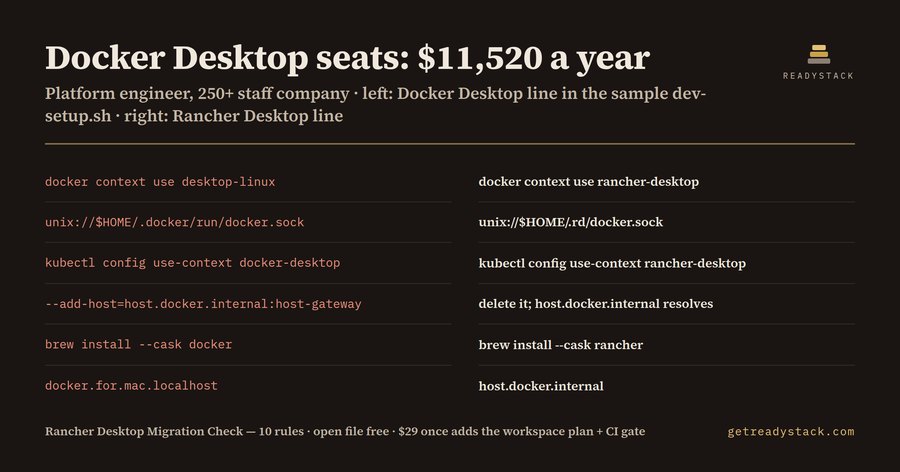
Docker Desktop Rancher Migration — find Docker Desktop lines andFinds Docker Desktop-only lines in development files and prints the corresponding Rancher Desktop line.FreeFull version $29
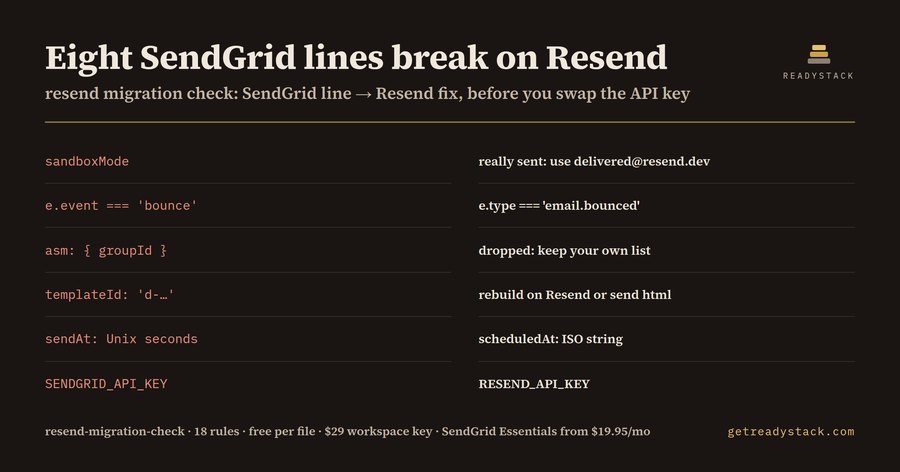
Resend SendGrid Migration — check your code for freeThis free tool flags SendGrid calls, fields and webhook events without a direct Resend equivalent and shows what to write instead.FreeFull version $29SBOM Field Check - CycloneDX and SPDX against the CRA 2026 barNames every missing field in your CycloneDX or SPDX SBOM against BSI TR-03183-2 and the CISA 2026 minimum elements. 34 rules. Runs offline.FreeFull version $29
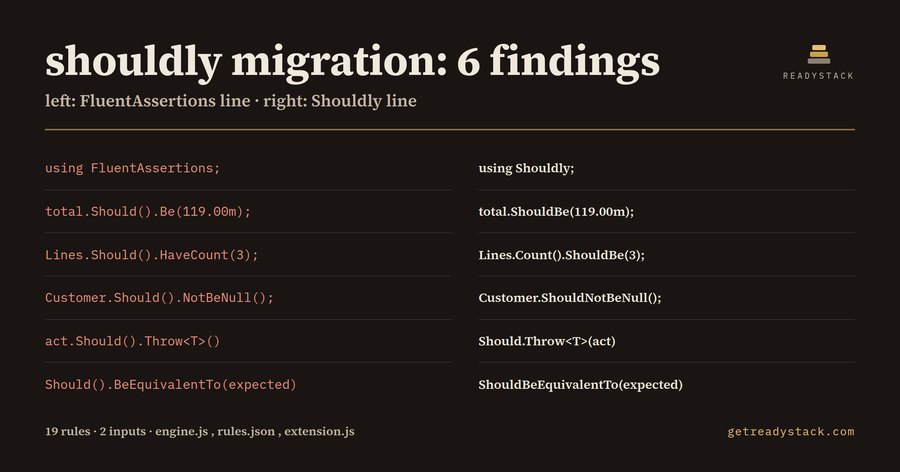
FluentAssertions 8 license — find replacements and license flagsMaps FluentAssertions lines in project and C# test files to Shouldly replacements and flags version 8 or later.FreeFull version $29
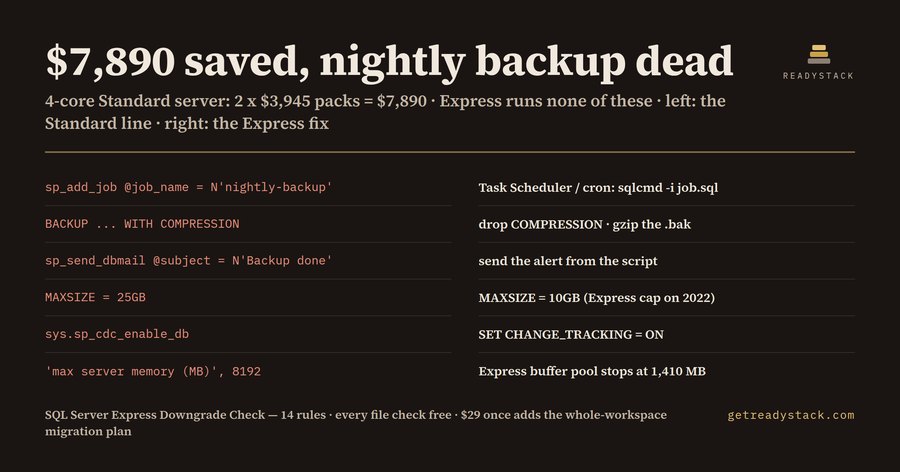
SQL Server Express limits — check your configuration freeCheck T-SQL, ini, and compose lines for features SQL Server Express cannot run and see the Express fix.FreeFull version $29Target API 36 & Xcode 26 Store Deadline LintFinds the targetSdk, NDK, Gradle plugin and Xcode versions in your repo that Google Play and App Store Connect already refuse, with the…FreeReadyStack
Calculators, templates and deadlines for the rules that change every year — free in your browser.