Checks a README or export notice against the US EAR 742.15(b) publication items: BIS and NSA emails, published source URL, ECCN line and notification date.

Try it freeFull version · $149 once →
What you get: Sweep every Markdown file in the repository and write a dated cryptoExport-report.md you keep and hand over: scope and ownership, not a limit on the free check.
Updated 2026-09-22 · ReadyStack
Checks a README or EXPORT notice against the US EAR 742.15(b) publication items: BIS and NSA emails, published source URL, ECCN line, notification date, and the removed 740.13(e) citation. Runs entirely in your browser — nothing is uploaded.
Same engine as the VS Code extension, byte for byte.
Free for the file open in your editor - no key, no limit. The workspace sweep and the report ask for a key.
VS Code MarketplaceOpen VSX (Cursor, VSCodium)npmMCP server (npx)ext install ReadyStack.crypto-export-notice-lint npx @readystack/crypto-export-notice-lint <file> npx @readystack/crypto-export-notice-lint --mcp
Team? One key for every ReadyStack linter, 5 seats, $149 once
Sweep every Markdown file in the repository and write a dated cryptoExport-report.md you keep and hand over: scope and ownership, not a limit on the free check.
One payment, one licence key for this tool. The key is shown right after payment.
US export-control counsel is commonly quoted at 300-600 USD per hour, and a release review is not billed in minutes.
Buy the full version — $29Need more than this one? ReadyStack Pass opens all 679 files and 561 full versions — $29/month or $199/year. See the Pass →
· ReadyStack
Real numbers from this tool, line by line.
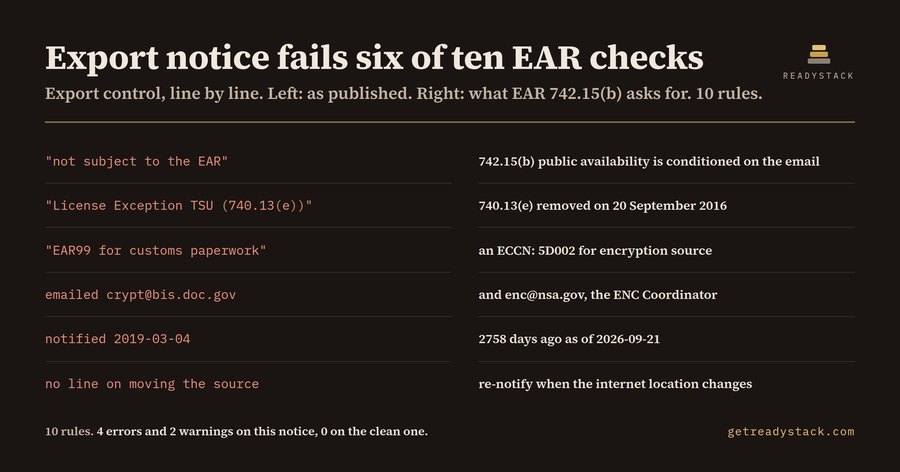
Six of ten export checks failed on one ordinary open-source notice, on a US-published secrets vault. The code was fine; the paragraph under "Export notice" was not.
That paragraph is where the US export rule actually lands. When you publish encryption source code from the United States, EAR 742.15(b) does not ask about your cipher suite. It asks whether you emailed the internet location of that source to [email protected] and to [email protected], and it asks again whenever that location changes. The public-availability position most maintainers rely on is conditioned on that email, and the notice in the repository is usually the only record that it ever went out.
Here is the notice we ran, shortened but otherwise as written:
"This project is publicly available open source, so it is not subject to the EAR and no export licence is required to download it. We publish the source under License Exception TSU (EAR 740.13(e)) and treat the package as EAR99 for customs paperwork. The notification email was sent to [email protected] on 2019-03-04."
Ten checks ran against it. Six came back, four errors and two warnings:
The clean notice shipped beside it, with both addresses, ECCN 5D002, a dated notification and a re-notify sentence, returns zero findings. The distance between the two files is about six lines of text.
Why not ask an assistant? Because the sentence an assistant hands you is sentence two above. Models reproduce the text they learned, and the pre-2016 phrasing is far more common online than the current one. More to the point, no chatbot can read the date sitting in your own notice, count 2758 days against today, and tell you which releases that email failed to cover. That is a job for something that reads your file.
Crypto Export Notice Lint is a VS Code extension and a single web page running one engine, byte for byte the same. Free and without a key: all ten checks on the notice open in the editor, marked line by line in the Problems panel, no run limit, no network call. The licensed part is a different job rather than a smaller one, on the scope and ownership axis: sweep every Markdown file in the repository and write a dated report file you keep and hand to whoever asks for it.
The yardstick is easy to name. US export-control counsel is commonly quoted at 300-600 USD per hour, and a release review is not billed in minutes.
The calendar does not stop at the email: maintainers on the mass-market encryption paths also owe an annual self-classification report by 1 February for what shipped the year before. The export paragraph is where that trail starts.
It reads the export-control paragraph in your Markdown — README, EXPORT, NOTICE, SECURITY — and reports which of ten documented items are absent or wrong: the [email protected] and [email protected] addresses, the published source URL, an ECCN such as 5D002, the notification date, the removed 740.13(e) citation, and the line about re-notifying when the source moves.
Maintainers and founders who publish source code containing encryption from the United States: the person who tags a release of a password manager, an end-to-end messaging client, a database with encryption at rest, or an SDK that wraps libsodium or OpenSSL. Also the security engineer who inherits that repository and its export paragraph.
Because the paragraph most assistants reproduce cites License Exception TSU at EAR 740.13(e), which BIS removed in the encryption rule of 20 September 2016 and replaced with the notification in 742.15(b). A generative answer restates the text it learned; it cannot tell you that your own notice is dated 2019 and missing [email protected].
Checking the file open in your editor against all ten checks is free forever, with no key, no watermark and no run limit. The licence key covers a different axis: sweeping every Markdown file in the repository and writing a dated report file you own.
Six findings on one ordinary-looking export paragraph — four errors and two warnings: no [email protected], no ECCN, a removed 740.13(e) citation, an EAR99 claim, a notification dated 2019-03-04 and no re-notify line. The clean notice shipped beside it returns zero. US export-control counsel is commonly quoted at 300-600 USD per hour.
A general AI chat answers from training data with a cutoff date, cannot read your repository and names no rule version. Crypto Export Notice Lint (EAR 742.15) checks the file you open against 10 rules from a rule set dated 2026-09-21, and points at the exact line. For a filing, an audit or a client you need that dated result on your own files.
One question, answered by the person who built it. Your email only if you want the answer sent.
Paste this code into your page. It runs in your visitor’s browser and stays up to date. Nothing your visitors type is stored.
For businesses: your name and logo instead of ours, and each visitor’s result + e-mail in your inbox (only when they tick consent) — Pro from $19/month. See Pro →
For a team or company: for an invoice with your company details, a quote or several licences, write to [email protected].
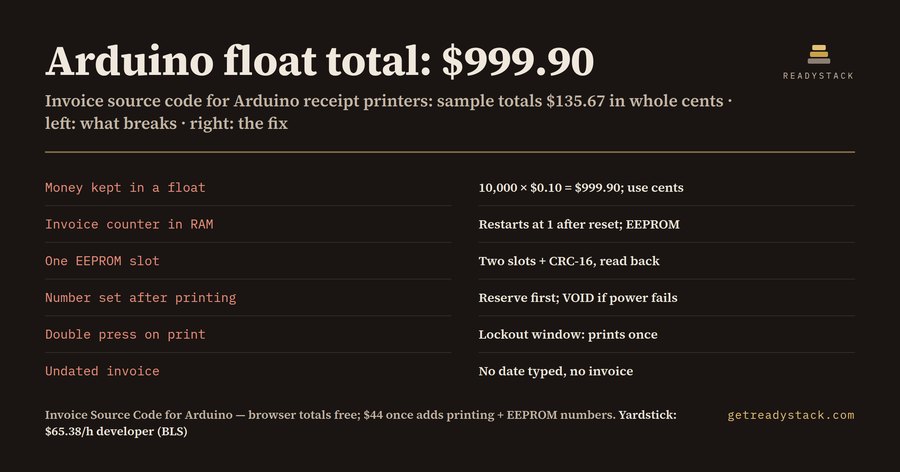
Invoice source code for Arduino: receipt totals in whole centsInvoice source code for Arduino: type your lines, get whole-cent totals, tax per rate and the exact 58 mm receipt your thermal printer will…FreeFull version $44
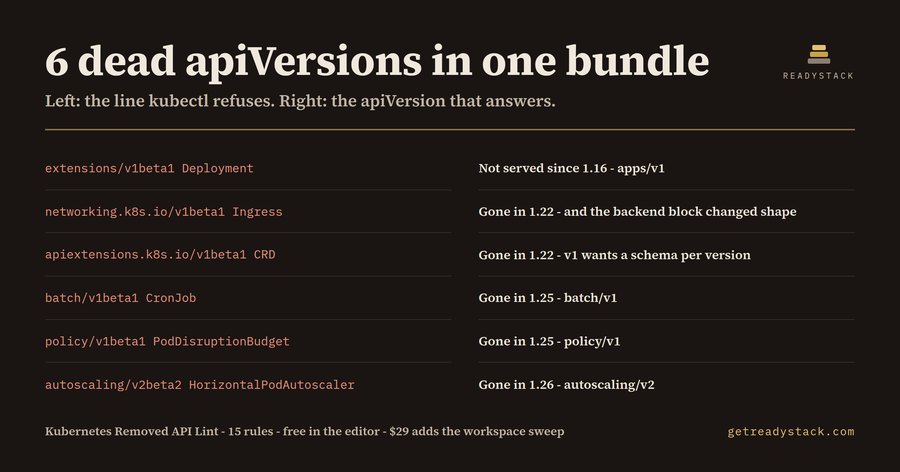
Kubernetes Removed API check — find removed api versions andThis offline browser tool finds Kubernetes apiVersions that kubectl no longer serves and provides the replacement for each.FreeFull version $29
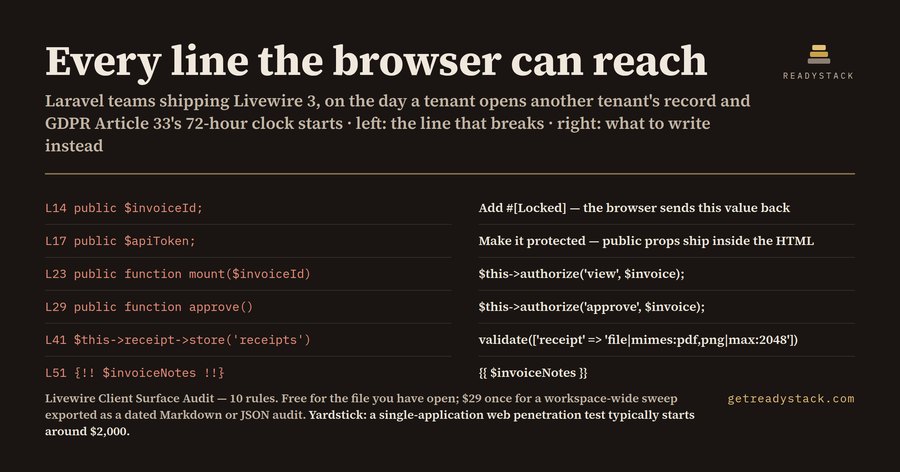
Laravel Livewire security check — find browser reachable linesThis browser tool finds lines in Laravel Livewire and Blade files that the browser can reach, change, or call and names a fix for each.FreeFull version $29
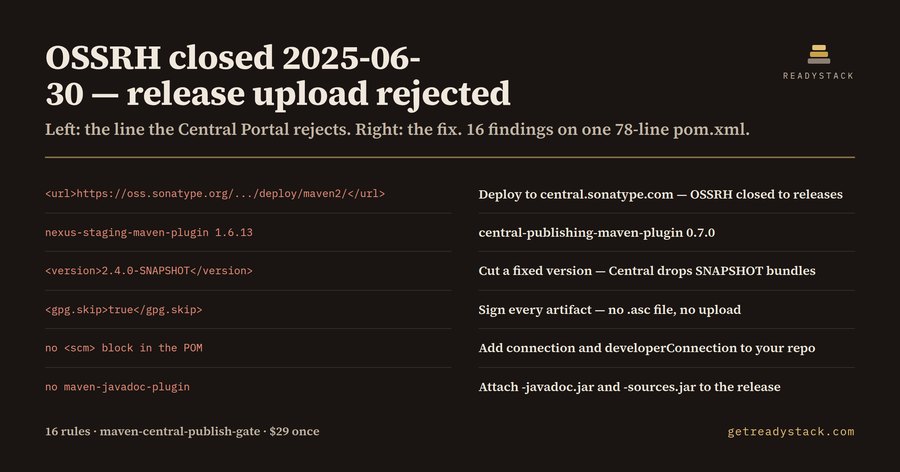
Maven Central Publish requirements — check your pom in browserThis free tool checks a pom.xml against the listed Maven Central Portal release rules.FreeFull version $29Model Sunset Lint - retired AI model IDs, datedFinds every model ID and API parameter in your code that a vendor has already switched off or has published a date for - 109 rules across…Free
n8n Social Media Workflow for Agency Content Approval — 6 Client Sign-Off Automations for Marketing Agencies6 workflows, 2 of them free on the n8n template library — every request, reminder, decision and publish hand-off timestamped in your own…FreeFull version $59ReadyStack
Calculators, templates and deadlines for the rules that change every year — free in your browser.