This browser tool identifies lines where a Node or TypeScript service writes personal data into logs, crash reports, or analytics.

Try it freeFull version · $149 once →
What you get: Runs the same 22 rules across every .js/.ts file in the workspace and writes the findings out as a report file you keep for CI, the ticket or the auditor.
Updated 2026-09-13 · ReadyStack
Names every line where your Node/TypeScript service writes personal data into logs, crash reports and analytics: console.log(req.body), pino without redact, sendDefaultPii: true. 22 rules. Runs entirely in your browser — nothing is uploaded.
Same engine as the VS Code extension, byte for byte.
Free for the file open in your editor - no key, no limit. The workspace sweep and the report ask for a key.
VS Code MarketplaceOpen VSX (Cursor, VSCodium)npmMCP server (npx)ext install ReadyStack.log-pii-telemetry-lint npx @readystack/log-pii-telemetry-lint <file> npx @readystack/log-pii-telemetry-lint --mcp
Team? One key for every ReadyStack linter, 5 seats, $149 once
Runs the same 22 rules across every .js/.ts file in the workspace and writes the findings out as a report file you keep for CI, the ticket or the auditor.
One payment, one licence key for this tool. The key is shown right after payment.
GitHub Advanced Security lists at $49 per active committer per month ($30 Code Security + $19 Secret Protection) and looks for secrets, not for a customer's name travelling in a log line.
Buy the full version — $29Need more than this one? ReadyStack Pass opens all 679 files and 561 full versions — $29/month or $199/year. See the Pass →
· ReadyStack
Real numbers from this tool, line by line.
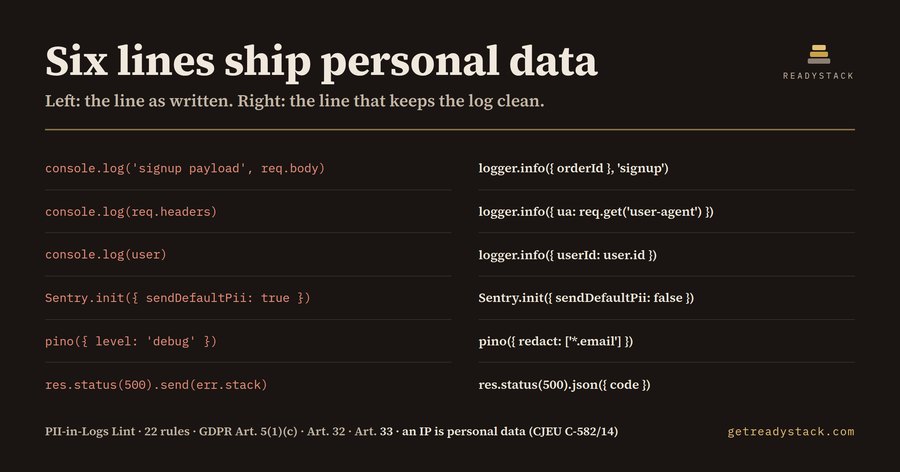
Twenty-four findings in forty-five lines. That is what the fixture shipped with PII-in-Logs Lint returns for one Express signup route — the kind a Node engineer in Berlin or Dublin inherits in their first week — and fifteen of those twenty-four are errors, not style warnings.
The file is not badly written. It is written the way a coding assistant writes it. Ask one to "add logging to this handler" and it logs the object it has, because the object it has is the request:
console.log('signup payload', req.body);
That line compiles, passes review, and runs for years. It copies every signup body — name, email, date of birth, sometimes a card — into stdout, into the log shipper, into the vendor's index, and into backups that outlive the service.
Art. 5(1)(c) says collect the minimum, Art. 32 says secure what you hold, and Art. 33 gives you seventy-two hours to notify a supervisory authority once you become aware of a personal-data breach. The clock starts the day someone opens the log viewer and sees a customer's address — which is how a line written in 2023 becomes a deadline in 2026. The next wave of US state privacy laws lands on 1 January 2027.
Some of the twenty-four never mention a person. morgan('combined') writes the client IP on every request, and an IP address is personal data in the EU — CJEU C-582/14, *Breyer*. sendDefaultPii: true tells the Sentry SDK to attach the IP, cookies, headers and request body to every event.
Another group lives in the bootstrap file: pino({ level: 'debug' }) with no redact, a winston file transport with no maxFiles — Art. 5(1)(e) storage limitation has no "forever" setting — a DEBUG=*, and an ORM started with log: ['query']. None of them appear in a diff that only touched a route handler.
The second fixture is the same service: same route, same framework, same error handling. It logs { orderId } instead of req.body, initialises pino with a redact list, sets sendDefaultPii: false, gives the file transport a maxFiles, and returns an error code instead of a stack. It scores 0 findings against all 22 rules. None of those fixes are hard. They are just invisible until something counts them.
ESLint's no-console treats every console call identically, which is why teams switch it off — it cannot tell req.body.orderId from req.body. Secret scanners look for keys and tokens; a customer's name is neither. A chatbot will explain Art. 33 to you but cannot see that line 30 of routes/signup.js is the problem. The gap is not knowledge. It is location.
Twenty-two rules, plain regular expressions you can read in ext/rules.json before you trust them: request objects, person records and fields, credentials and sessions, logger configuration, third-party sinks, outward leaks, source hygiene. Each finding gives the line, the rule, the article and the fix.
The file you have open is free — all 22 rules, no key, no limit. The paid tier, $29 once, runs the same rules across every .js and .ts file in the workspace and writes the findings to a report file you keep. One licence key per person or CI seat. GitHub Advanced Security lists at $49 per active committer per month and hunts secrets rather than people.
Run the same 22 rules free, in the browser, on one file: https://getreadystack.com/tools/log-pii-telemetry-lint
It reads a JavaScript or TypeScript file and marks each line that sends personal data to a log sink: console.log(req.body), a whole user record, a password or token argument, sendDefaultPii: true, morgan('combined') writing the client IP, pino with no redact option, or a stack trace returned to the caller. Each finding names the rule and the fix.
Node and TypeScript backend engineers whose service handles EU personal data, and the platform engineer who has to say which services log what. It is written for the person who inherited a repo where logging was added by a coding assistant and nobody has read every console call since.
ESLint's no-console rule treats every console call the same way, so teams switch it off; it cannot tell req.body.orderId from req.body. Secret scanners hunt keys and tokens, which are not personal data. Neither one knows that an IP address is personal data in the EU under CJEU C-582/14.
The file you have open is free, with all 22 rules, no key and no limit — you can clean a file with it and never buy anything. The paid tier, $29 once, runs the same rules across every .js and .ts file in the workspace and writes the findings to a report file you keep. Scope and ownership, not crippled rules.
GitHub Advanced Security lists at $49 per active committer per month, split as $30 Code Security and $19 Secret Protection, and it looks for secrets rather than for personal data in log lines. A privacy engineer reading one service's logging calls by hand is a day of work per service, repeated each release.
A general AI chat answers from training data with a cutoff date, cannot read your repository and names no rule version. PII-in-Logs Lint (console.log(req.body)) checks the file you open against 22 rules from a rule set dated 2026-09-20, and points at the exact line. For a filing, an audit or a client you need that dated result on your own files.
One question, answered by the person who built it. Your email only if you want the answer sent.
Paste this code into your page. It runs in your visitor’s browser and stays up to date. Nothing your visitors type is stored.
For businesses: your name and logo instead of ours, and each visitor’s result + e-mail in your inbox (only when they tick consent) — Pro from $19/month. See Pro →
For a team or company: for an invoice with your company details, a quote or several licences, write to [email protected].
EU einvoice 2026 requirements — check invoice xml freeThis browser tool checks UBL or CII invoice XML against EN 16931 and listed 2026 country mandates, and flags retired schema versions.FreeFull version $29ERB Snippets + View Audit for RailsPaste one .html.erb view and see the raw, html_safe, params and CSRF findings a Rails security review sends back. 26 rules, runs in your…Free
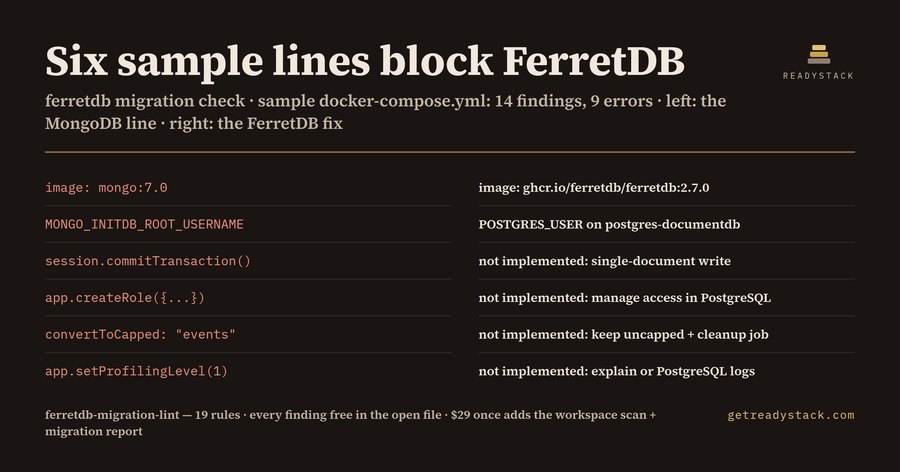
FerretDB MongoDB Migration — check your files for freeThis free tool flags SSPL MongoDB server images and commands FerretDB does not implement, with a fix for each line.FreeFull version $29
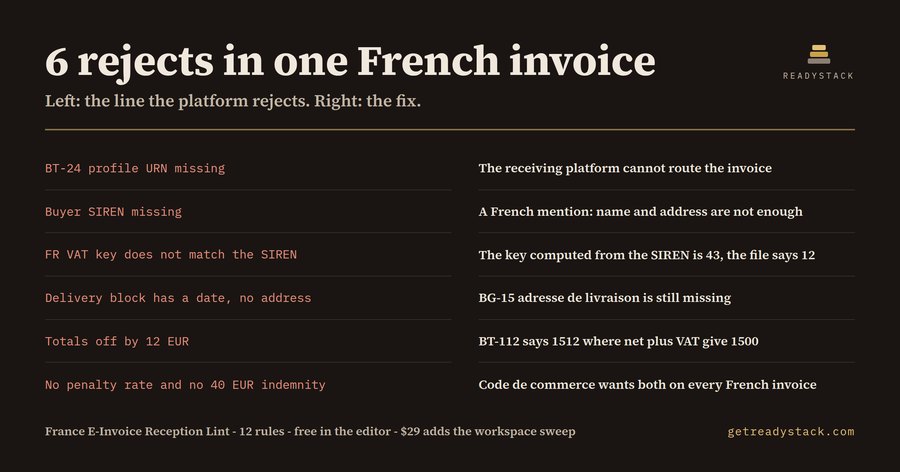
France E Invoice mentions 2026 — check your french invoices freeLint Factur-X, UBL and CII invoices for the French mandatory mentions a PDP rejects: SIREN Luhn, FR VAT key, delivery address, operation…FreeFull version $29
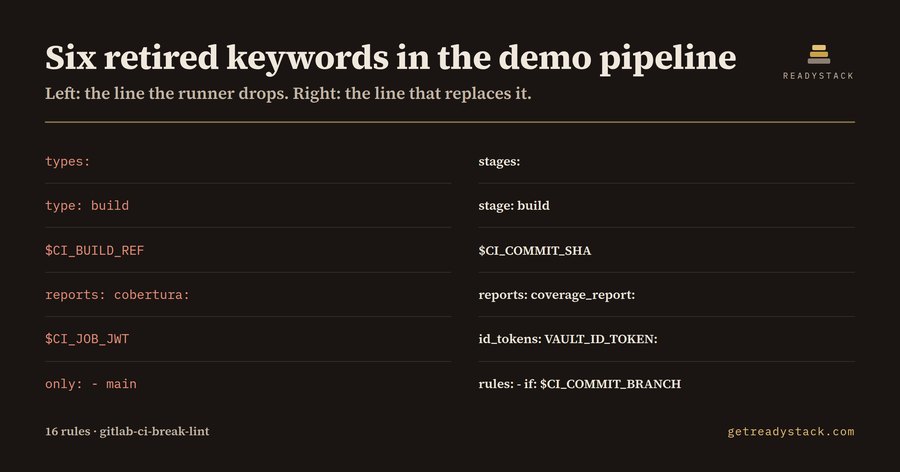
GitLab CI retired keywords — check your pipeline file onlineThis free tool finds retired GitLab CI keywords and GitHub Actions syntax in a .gitlab-ci.yml file.FreeFull version $29
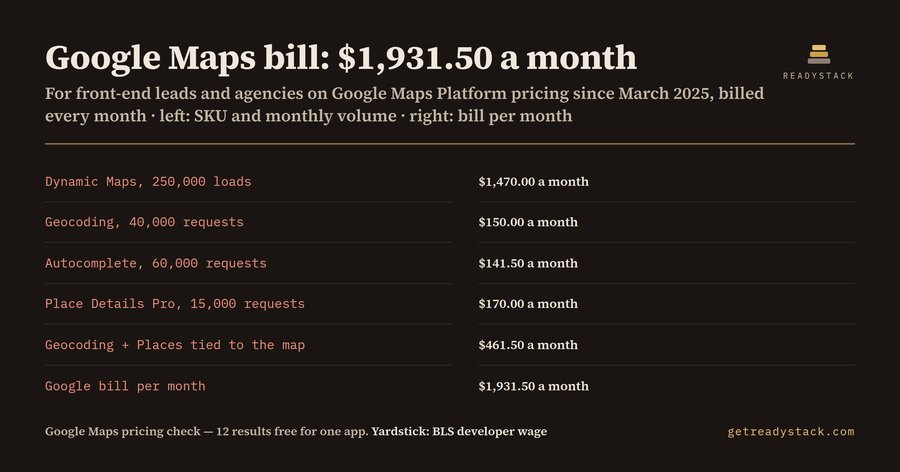
Google Maps Platform pricing: OpenLayers migration checkGoogle Maps Platform pricing calculator: per-SKU free caps since March 1, 2025, the Geocoding and Places that must leave with the map, and…FreeFull version $21ReadyStack
Calculators, templates and deadlines for the rules that change every year — free in your browser.