Score goals and competencies, get the rating, then the merit raise in dollars.

Try it freeFull version · $21 →
Updated 2026-10-12 · ReadyStack
Score goals and competencies, get the rating, then the merit raise in dollars. Check that raise against the 3.1% wage growth BLS measured for June 2026. A raise below it means a 'meets expectations' employee's pay falls behind the market.
| Weighted review score | 3.8 |
| Rating band (1-5) | 4 |
| Compa-ratio (salary / midpoint) | 0.96 |
| Rating multiplier (5=1.5, 4=1.2, 3=1.0, 2=0.5, 1=0) | 1.2 |
| Range position factor (below 0.90 = 1.25, above 1.10 = 0.75) | 1 |
| Merit raise % | 4.20% |
| Merit raise ($ per year) | $3,024.00 |
| New annual salary | $75,024.00 |
| Raise needed to keep pace with market | $2,232.00 |
| Raise above (+) or below (-) market | $792.00 |
| New compa-ratio | 1 |
Full version — $21 once · the .xlsx with the printable Review Form and a 15-row Team Calibration sheet checked against your merit pool · Get the workbook
Everything updates as you type. Nothing is uploaded. This runs in your browser.
BLS Employment Cost Index: private-industry wages and salaries rose 3.1% in the 12 months to June 2026. A raise below that pace is a pay cut against the market, even with a "meets expectations" rating.
Free performance review templates are blank forms that stop at the rating. This one turns the rating into dollars: weighted score → rating band → compa-ratio merit matrix → raise → gap to market.
Merit matrix used: rating 5 = 1.5×, 4 = 1.2×, 3 = 1.0×, 2 = 0.5×, 1 = no raise, times your merit budget. Below 0.90 compa-ratio the raise is ×1.25; above 1.10 it is ×0.75. These are a starting matrix, not a law. Change them in the workbook to match your company's policy.
Yardstick: BLS OEWS 2025: Human Resources Specialists median $36.51/h; Compensation, Benefits and Job Analysis Specialists median $37.60/h.
The workbook opens directly in Excel. For Google Sheets, use File ▸ Import ▸ Upload (menu names vary by version and language). Formulas are plain arithmetic, IF, ROUND, SUM, AVERAGE and COUNTIF, and they work in both. Fill colours and column widths can look slightly different in Sheets.
$21 once buys the .xlsx workbook with 4 worksheets. Inputs and Merit Raise hold the same live formulas as the web page. Review Form is a printable review with 3 goals, 5 competencies, comments and signatures. Team Calibration has 15 employee rows that each compute their own raise, plus a total check
One payment, one licence key for this tool. The key is shown right after payment.
BLS OEWS 2025: Human Resources Specialists median $36.51/h; Compensation, Benefits and Job Analysis Specialists median $37.60/h. A human compensation analyst at that rate is the yardstick for an hour of merit-matrix work. BLS Empl
Buy the full version — $21I have a keyThis tool is 1 of 267 paid tools in English. All 267 with one key: Freelancer & Small Business Pass — $9.99/month · $79/year · Deadline reminders by email (free)
Need more than this one? ReadyStack Pass opens all 679 files and 561 full versions — $29/month or $199/year. See the Pass →
Paste this code into your page. It runs in your visitor’s browser and stays up to date. Nothing your visitors type is stored.
For businesses: your name and logo instead of ours, and each visitor’s result + e-mail in your inbox (only when they tick consent) — Pro from $19/month. See Pro →
· ReadyStack
Real numbers from this tool, line by line.
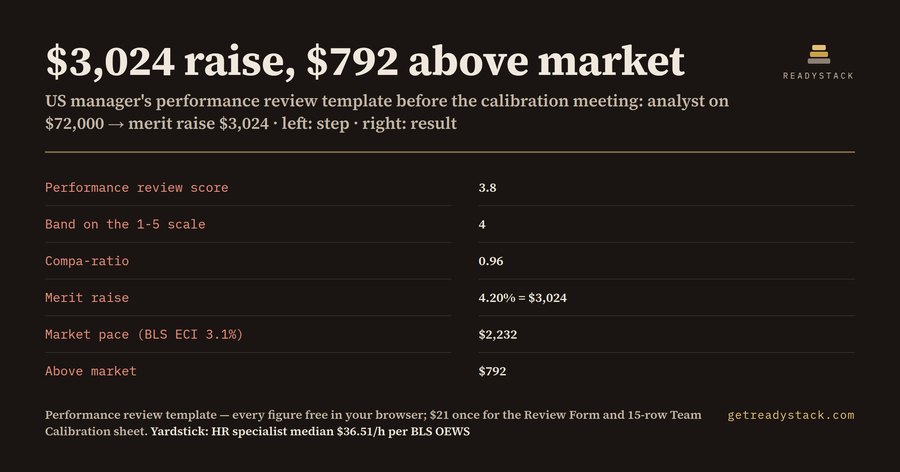
A US manager rating an analyst on $72,000 lands at a $3,024 merit raise, which is $792 above market. That is with a 3.5% merit budget, a $75,000 range midpoint, a goals score of 4 and a competency score of 3.5.
| Step | Result |
|---|---|
| Weighted review score (60% goals) | 3.8 |
| Rating band | 4 |
| Compa-ratio | 0.96 |
| Merit raise | 4.20% = $3,024 |
| New salary | $75,024 |
| Market-pace raise (3.1%) | $2,232 |
| Above market | $792 |
Now change three numbers. The employee is an associate on $61,000 with a $62,000 midpoint, scoring 2 on goals and 2.5 on competencies. The weighted score drops to 2.2 and the band to 2. The multiplier halves, so the raise is 1.75% = $1,068. Keeping pace with the market would take $1,891, so this raise is $823 below market.
The market line comes from a federal figure, not an opinion. BLS Employment Cost Index: private-industry wages and salaries rose 3.1% in the 12 months to June 2026. Any raise under that pace means the employee's pay falls behind the market, whatever the rating says.
Most performance review templates are blank forms. They give you rating boxes, comment fields and a signature line, and then they stop. The question every employee asks after the meeting is "what does this mean for my pay?", and a blank form cannot answer it. Calibration has the same gap: HR asks whether the raises fit the merit pool, and nobody has added them up.
The goals and competency scores are weighted into one score from 1 to 5 and rounded to a rating band. The band sets a multiplier on your merit budget: 1.5 for a 5, 1.2 for a 4, 1.0 for a 3, 0.5 for a 2 and zero for a 1. Then compa-ratio adjusts it. Someone paid below 0.90 of the range midpoint gets 1.25 times that raise, and someone above 1.10 gets 0.75 times. That is a starting matrix, not a law, so change it to match your company's policy.
The workbook's Team Calibration sheet holds 15 employee rows. Its four example employees have a payroll of $333,000. A 3.5% budget gives a pool of $11,655, while the matrix hands out $14,140 in raises, overspent by $2,485. You want to find that the evening before calibration, not in the meeting.
The web calculator is free, with no account. It shows one employee's whole answer from your own numbers. The workbook adds the printable Review Form, with 3 weighted goals, 5 competencies, comments and 3 signature lines, plus the Team Calibration sheet. It opens in Excel, or in Google Sheets through File, Import, Upload.
BLS OEWS 2025: Human Resources Specialists median $36.51/h; Compensation, Benefits and Job Analysis Specialists median $37.60/h. One hour of someone building a merit matrix by hand costs more than the workbook does.
Put in your employee's scores and salary before the review meeting, and check the gap to market line before you say a number out loud.
You enter the goals and competency scores. It weights them into one score and sets a rating band from 1 to 5. Then it applies a merit matrix based on compa-ratio and returns the raise in dollars and the new salary. The default example is a $72,000 employee rated 4. The answer is a 4.2% raise of $3,024, which is $792 above the 3.1% BLS ECI market pace.
It is for US people managers and HR generalists running annual reviews. Each rating has to become a merit raise that survives calibration and matches the merit budget. It suits teams that score goals and competencies on a 1-5 scale and have salary ranges with a midpoint. It works for one direct report or a full team.
Free performance review templates are blank forms that stop at the rating. They never turn a 4 out of 5 into dollars or compare the raise with market wage growth. BLS Employment Cost Index: private-industry wages and salaries rose 3.1% in the 12 months to June 2026, so a 2.5% raise for a solid performer is still a pay cut against the market.
The web calculator is free with no account. It shows one employee's whole answer: score, band, compa-ratio, merit raise % and dollars, new salary and the market gap. The $21 .xlsx adds the printable Review Form and a Team Calibration sheet with 15 employee rows. Each row computes its own raise, and the total is checked against your merit pool.
BLS OEWS 2025: Human Resources Specialists median $36.51/h; Compensation, Benefits and Job Analysis Specialists median $37.60/h. One hour of an analyst building a merit matrix and checking it against ECI already costs more than this one-time $21 file. You keep the file and reuse it every review cycle.
One question, answered by the person who built it. Your email only if you want the answer sent.
For a team or company: for an invoice with your company details, a quote or several licences, write to [email protected].
Section 232 Tariff Calculator 2026 — Steel, Aluminum & Copper Duty on Full ValueSince April 6, 2026 the Section 232 duty is charged on the full customs value, not the metal content (Proclamation 11021). Entering on the…FreeFull version $21TikTok Shop Fee Calculator 2026 — 6% vs 8% Referral Fee Profit CheckFor US TikTok Shop sellers: profit per order and per month after the referral fee, creator commission, returns and the refund admin fee.…FreeFull version $21
Form 8850 due date and WOTC credit for one hireForm 8850 is due 28 calendar days after a start date. During the 2026 WOTC authority lapse the clock still runs.FreeFull version $60
Self Assessment Workbook 2025-26 UK ExcelYour 31 January 2027 Self Assessment bill in one figure — the 2025-26 balancing payment plus your first 2026-27 payment on account — with…FreeFull version $14.99
Construction Project Dashboard Template — Earned Value, Float & RFI Control (Power BI)Your team already pays $14 per user/month for Power BI Pro (Microsoft list price effective 1 April 2025) and it still opens on an empty…FreeFull version $69
Etsy fee Calculator — Etsy Profit Calculator 2026One sale that Etsy attributes to an Offsite Ad costs 15% of the order total (12% once your shop has sold $10,000 in 365 days), up to $100…FreeFull version $21ReadyStack
Calculators, templates and deadlines for the rules that change every year — free in your browser.